The short answer
Cultivation levels, also called realms, are named stages of power and transformation in Chinese fantasy stories.
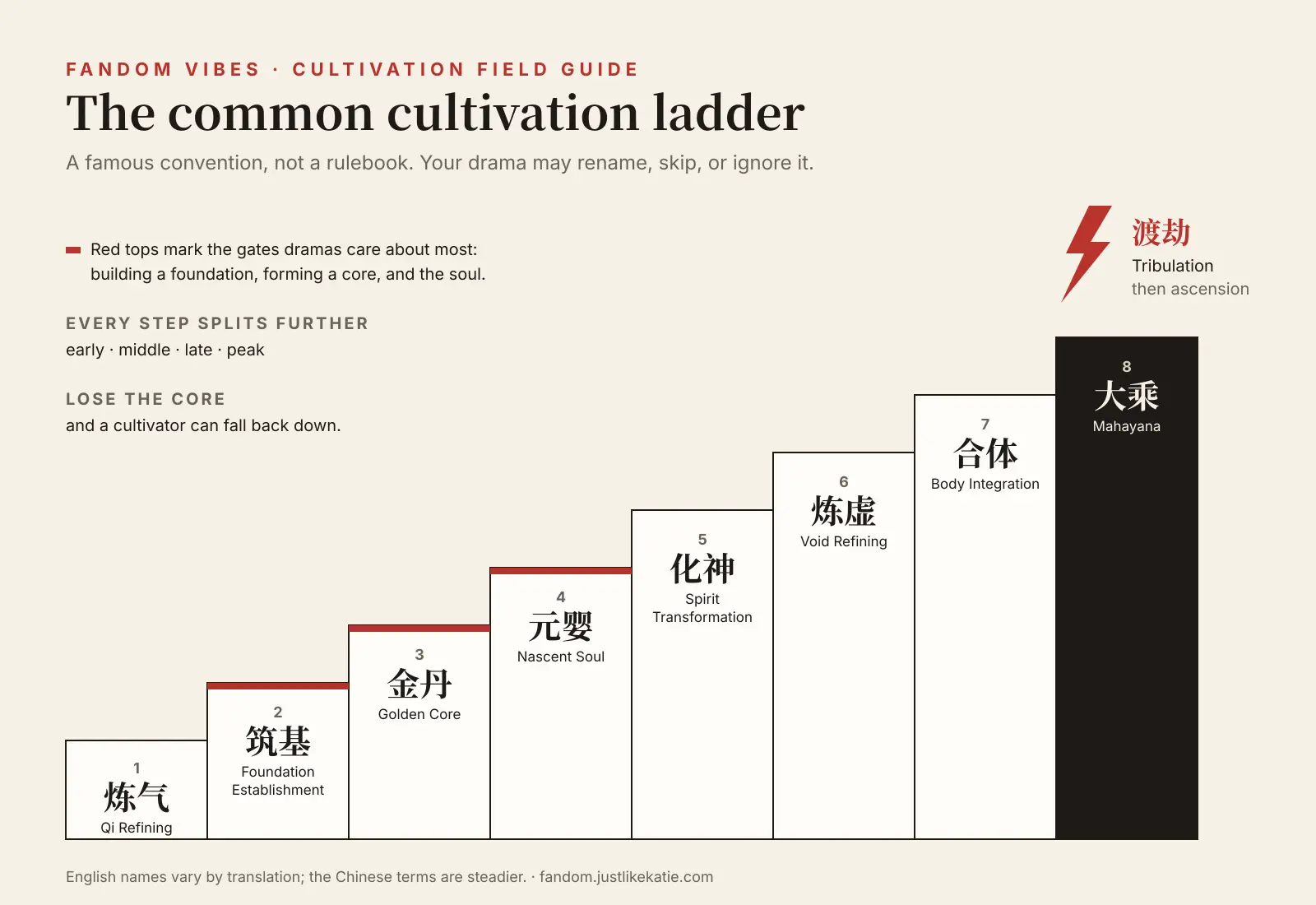
The most widely copied ladder, popularized by web novels such as A Record of a Mortal’s Journey to Immortality, runs from Qi Refining through Foundation Establishment, Core Formation, and Nascent Soul toward Mahayana and ascension. Many dramas borrow pieces of it; many invent their own.
Treat the ladder below as a reference map, not a rulebook. Each story is responsible for teaching you its own system. For what cultivation is in the first place, start with the cultivation guide.
The common ladder
| # | Level | Common English names | What the stage usually means |
|---|---|---|---|
| 1 | 炼气 liàn qì | Qi Refining, Qi Condensation | Sensing and gathering spiritual energy. The entry point that separates cultivators from ordinary people. |
| 2 | 筑基 zhù jī | Foundation Establishment, Foundation Building | Building a stable base that can hold real power. Often the first true gate, and the first big lifespan gain. |
| 3 | 结丹 jié dān / 金丹 jīn dān | Core Formation, Golden Core | Condensing energy into an inner core. Losing or damaging a core is a recurring crisis. |
| 4 | 元婴 yuán yīng | Nascent Soul | A soul-self forms that can, in many stories, survive the body’s destruction. |
| 5 | 化神 huà shén | Spirit Transformation, Deity Transformation | Power begins to touch the laws of the world itself. Rare enough that whole regions may have none. |
| 6 | 炼虚 liàn xū | Void Refining, Void Training | Mastery over space and emptiness. |
| 7 | 合体 hé tǐ | Body Integration, Body Fusion | Body, soul, and the world’s energy merge. |
| 8 | 大乘 dà chéng | Mahayana, Great Ascension | The peak of the mortal realm, one step from leaving it. |
Many stories add a final crossing, a tribulation (渡劫, dù jié), before a cultivator can ascend. Most levels are also split into sub-stages, commonly early, middle, late, and peak (sometimes “great perfection”).
Why the English names never match
The Chinese terms are fairly stable; translations are not. 结丹 can appear as Core Formation, Golden Core, or Dan Formation depending on the novel, the subtitle team, or the platform. If your subtitles use a name you don’t recognize, check the Chinese term, not the English one.
How dramas use (and ignore) the ladder
Web-novel adaptations
These keep more of the ladder, because the source novel uses rank as plot structure.
Romance-led xianxia
These often compress it. A breakthrough matters for what it costs the relationship, not for its number.
Immortal-court dramas
These frequently use status titles instead, such as 上仙 (shàngxiān) and 上神 (shàngshén). Those are ranks in a celestial hierarchy, not training stages.
Wuxia
Wuxia rarely uses levels at all. Skill and internal force matter, but there is no ladder to immortality.
In The Untamed, for example, a cultivator’s golden core is the seat of their power, which is why the story treats any threat to a core so seriously. You don’t need the full ladder to feel that weight.
A three-part rank reading lens
Fandom Vibes field lens · Label → Gap → Story
A rank is a claim the story makes about what effort earns.
A level tells you what a character can do. The cultivation guide helps you read what they are becoming while they do it.
Common questions
What is the highest cultivation level?
It depends on the story. In the common ladder, Mahayana is the peak of the mortal world, followed by a tribulation and ascension. Many stories continue with immortal realms beyond that.
What is Nascent Soul?
The fourth stage of the common ladder: a soul-self forms that can often outlive the body. In many stories it is where a cultivator becomes a true power.
What is a golden core?
An inner core of condensed spiritual energy (金丹), formed at the third stage. Because power lives there, damage to a core is one of cultivation fiction’s biggest crises.
Do all C-dramas use these levels?
No. Some use part of the ladder, some use celestial rank titles, and some invent their own system entirely.
Today’s Vibe Atlas drop is a separate next step
This page maps a common cultivation ladder. Vibe Atlas is the daily collectible experience: one featured C-drama actor, one assigned vibe, and nine curated pieces of visual evidence. Today’s actor or role may not come from a cultivation story.
Browse today’s C-drama card dropEditorial and source note
This guide describes a recurring fantasy-story convention, not any religious or philosophical practice. Level names are checked against translated web-novel and subtitle usage; every fictional system remains responsible for teaching viewers its own rules.
Last editorial review: November 16, 2026.