The short answer
A Chinese fox spirit is a fox that has gained supernatural power, usually through long life or cultivation, and can take human form.
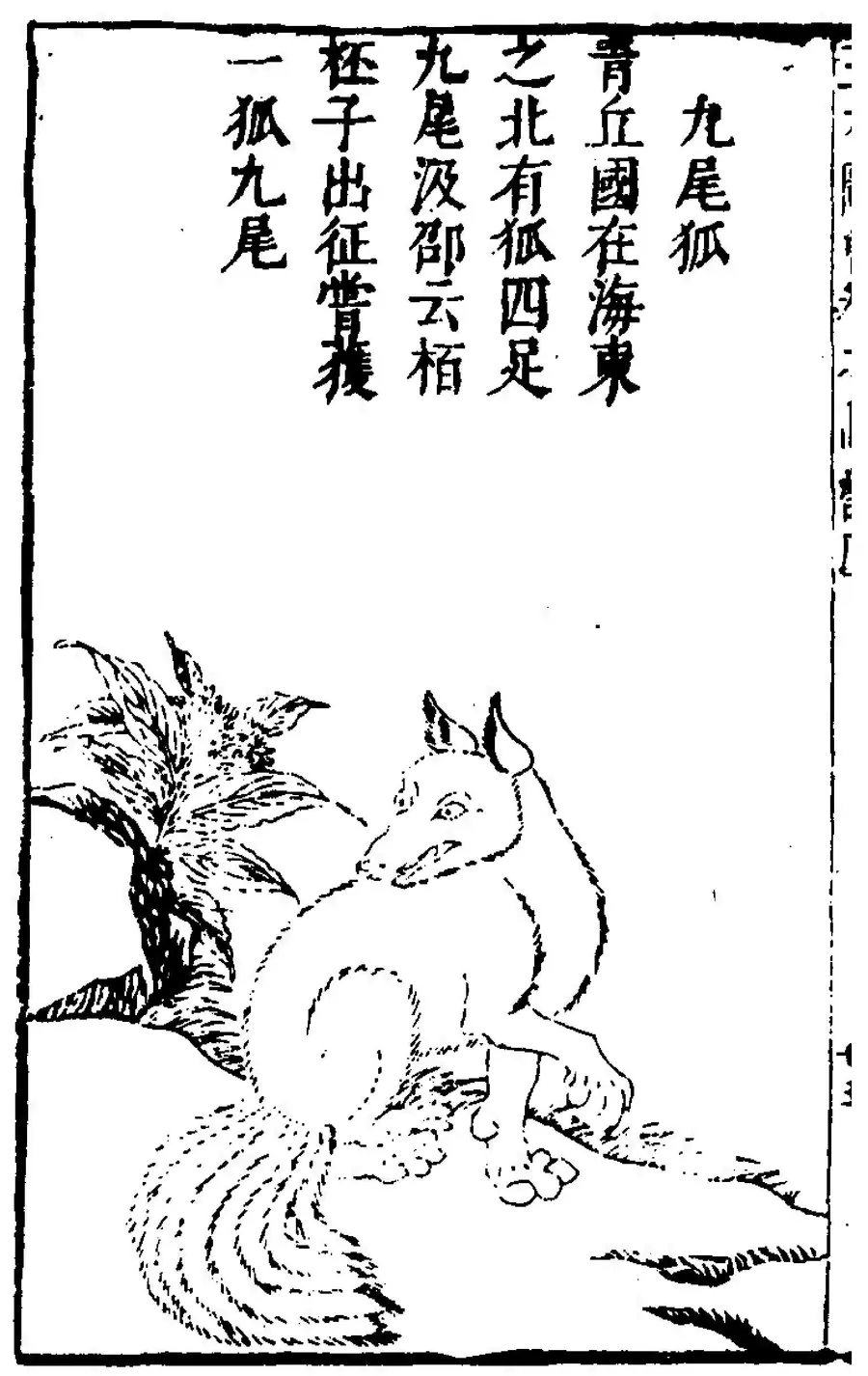
The most powerful are nine-tailed foxes (九尾狐, jiǔwěi hú), first recorded in the Classic of Mountains and Seas (山海经) as living in a land called Qingqiu (青丘).
Whether a fox spirit is a blessing or a threat depends on the story. Early texts treat the nine-tailed fox as an auspicious sign; later fiction made it a seductress; xianxia dramas often make it royalty.
Three Chinese fox words dramas mix up
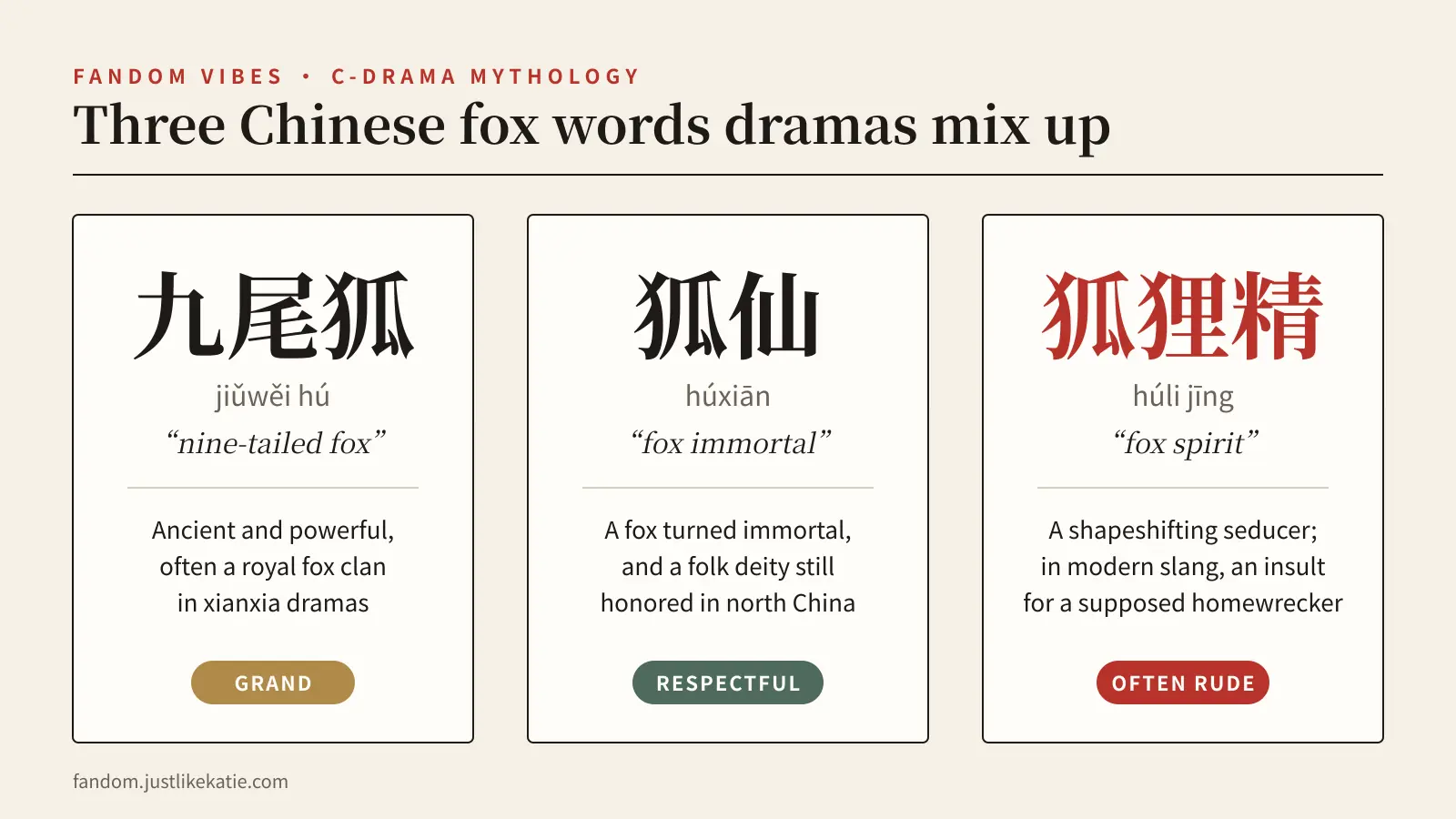
| Word | Literally | What it usually means | Tone |
|---|---|---|---|
| 九尾狐 jiǔwěi hú | nine-tailed fox | The mythic creature: ancient, powerful, often a clan or royal line in xianxia | Neutral to grand |
| 狐仙 húxiān | fox immortal | A fox that has become an immortal, and a folk deity still honored in north China | Respectful |
| 狐狸精 húli jīng | fox spirit, fox demon | A shapeshifting fox that seduces; in modern slang, an insult for a woman accused of stealing someone’s partner | Often negative |
The slang meaning matters for viewers. When a character hisses 狐狸精 at a rival, subtitles may say “vixen” or “seductress,” and nobody on screen is literally a fox. It belongs to the same family of insults as green tea (绿茶) and white lotus (白莲花).
From omen to villain to heroine
The omen
The Classic of Mountains and Seas, compiled before and during the early Han, places a nine-tailed fox in Qingqiu. Later tradition says Yu the Great saw a nine-tailed fox at Tushan (涂山) and took it as a sign to marry a Tushan woman. Here the fox means fertility and a worthy ruler.
The god
As 狐仙, fox immortals became objects of folk worship across north China, especially in the northeast, where households honored them for protection and prosperity.
The villain
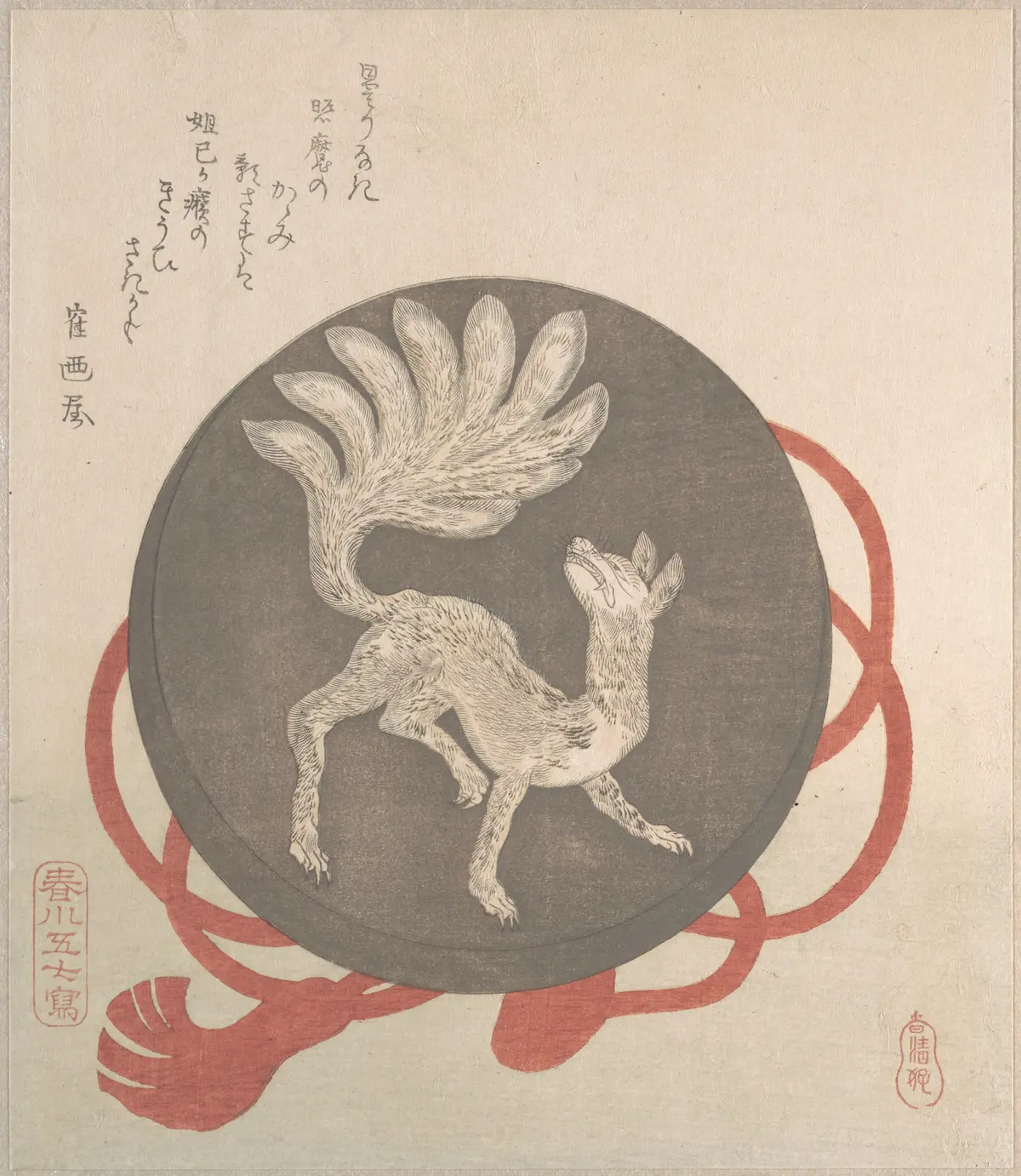
The Ming-dynasty novel Investiture of the Gods (封神演义, 16th century) has a thousand-year-old fox spirit possess Daji, the consort who helps bring down the Shang dynasty. That image of the fox as a beautiful destroyer still shadows fox characters today.
The heroine
Pu Songling’s Strange Tales from a Chinese Studio (1679) is full of fox women who are clever, loyal, and often more humane than the men around them. Modern xianxia builds on this sympathetic line.
Why nine tails?
In many tellings, a fox grows more powerful, and gains tails, as it ages. A widely cited early account attributed to the commentator Guo Pu lays out the stages: at fifty a fox can take a woman’s form, at a hundred it can become a beautiful woman or a spirit medium, and at a thousand it can ascend to heaven. Nine tails became the shorthand for a fox at the top of that ladder.
That’s why fox characters in cultivation dramas often count age in centuries, and why losing a tail can mean losing power or years of cultivation.
How C-dramas use fox lore
The royal fox clan
In Eternal Love (三生三世十里桃花, 2017), the heroine belongs to Qingqiu’s nine-tailed white fox clan, and the old place name becomes a kingdom.
The Tushan foxes
Fox Spirit Matchmaker (狐妖小红娘) builds its world around the foxes of Tushan, borrowing the setting of the Yu the Great legend.
The fox who cultivates
A fox spends centuries training toward human form or immortality, and a single choice for love can undo it.
The Daji shadow
A beautiful fox at court, blamed for a ruler’s ruin. The interesting dramas ask whether she is the cause or the scapegoat.
Chinese fox, Korean gumiho, Japanese kitsune
Most English-language nine-tailed fox searches come from K-drama viewers, so it helps to separate the three traditions. They share roots but tell different stories.
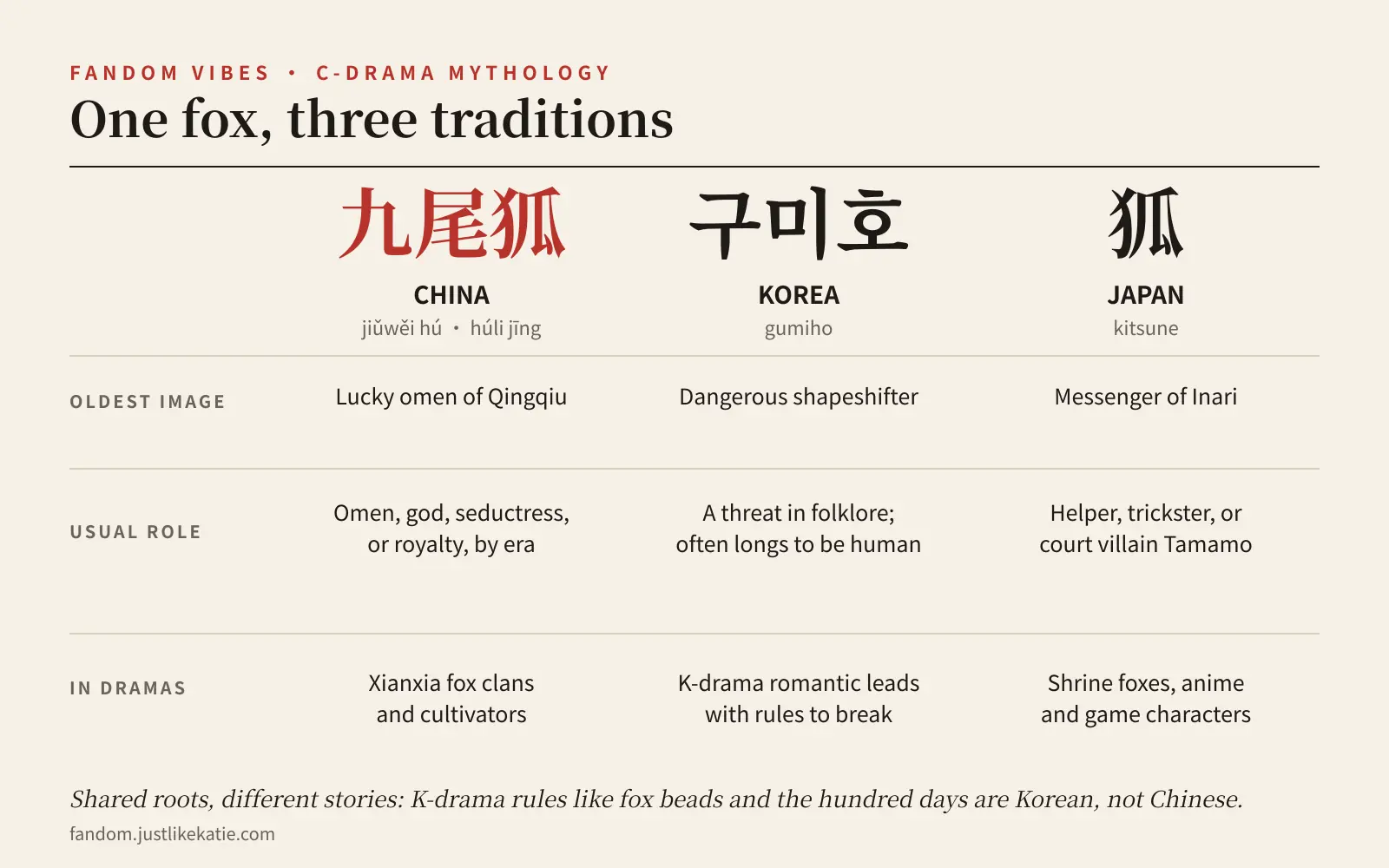
| China: 九尾狐 / 狐狸精 | Korea: gumiho 구미호 | Japan: kitsune 狐 | |
|---|---|---|---|
| Oldest image | Auspicious creature of Qingqiu | Dangerous shapeshifter | Messenger of the deity Inari |
| Usual role | Omen, god, seductress, or royal clan, depending on the era | Usually a threat in folklore; in modern K-dramas, often longs to become human | Helper, trickster, or (as nine-tailed Tamamo-no-Mae) a court villain |
| Typical in drama | Xianxia royalty and cultivators | Romantic leads with rules about becoming human | Shrine foxes, anime and game characters |
One legend links all three: the fox of three countries, who wrecks a kingdom in India, becomes Daji in China, and reappears in Japan as Tamamo-no-Mae.
What fox lore does not mean
Not every fox spirit is evil
Moral alignment depends on the era and the story.
Not every fox has nine tails
Many fox spirits have one or a few; nine marks the oldest and strongest.
Not every K-drama rule applies
Liver-eating, fox beads, and the hundred days to become human come from Korean storytelling, not Chinese lore.
Not always literal
狐狸精 in a modern drama is usually an insult, not a supernatural reveal.
A three-part fox reading lens
Fandom Vibes field lens · Omen → Desire → Form
A fox spirit shows you what a story fears and wants.
The Daji legend blamed a fox for a dynasty’s fall. A good fox drama lets you ask whether she was ever the real cause.
Common questions
What is a Chinese fox spirit?
A fox that has gained supernatural power through age or cultivation and can take human form. The general word is 狐狸精 (húli jīng); the most powerful are nine-tailed foxes.
Is the nine-tailed fox Chinese, Korean, or Japanese?
The earliest written record is Chinese, in the Classic of Mountains and Seas. Korea and Japan developed their own fox traditions, the gumiho and the kitsune, with different personalities and rules.
Is huli jing an insult?
It can be. In fantasy it means a fox spirit; in everyday modern Chinese it is a harsh insult for a woman accused of seducing someone’s partner.
What is Qingqiu?
The mythical land where the Classic of Mountains and Seas places the nine-tailed fox. Xianxia dramas often turn it into the fox clan’s kingdom.
Why do fox spirits have nine tails?
In many tellings, foxes grow stronger and gain tails as they age. Nine tails marks a fox at the height of its power.
Today’s Vibe Atlas drop is a separate next step
This page explains fox spirits across Chinese stories. Vibe Atlas is the daily collectible experience: one featured C-drama actor, one assigned vibe, and nine curated pieces of visual evidence. Today’s actor or role may not come from a fox story.
Browse today’s C-drama card dropEditorial and source note
This guide describes recurring folklore and fiction traditions. Fox deity worship (狐仙) is a living folk tradition and is described here respectfully, not explained in full. Facts were checked against the nine-tailed fox, fox spirit, Huxian, and Daji entries and the Confucius Institute for Scotland. The hero illustration and charts are original to Fandom Vibes; historical prints are credited beneath each image.
Last editorial review: November 9, 2026.