The short answer
White moonlight (白月光, bái yuèguāng) is an idealized person who stays luminous in someone’s memory because they are lost, distant, unavailable, or never truly possessed.
The term names a relationship between the one who remembers and the one remembered. It is not a personality type.
Literally, the characters mean “white” (白) and “moonlight” (月光): light that is beautiful, cool, and impossible to hold.
Where the image comes from
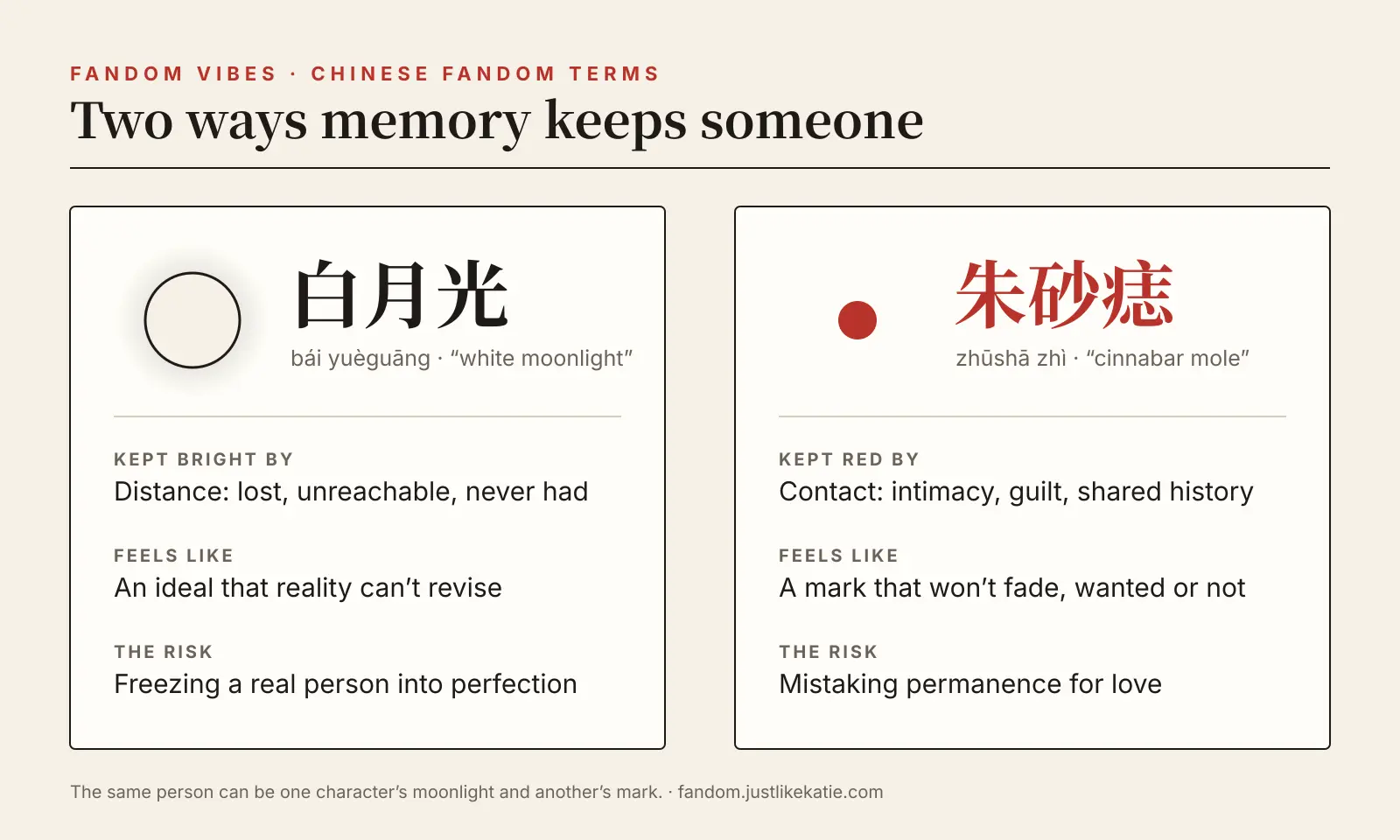
The modern image traces back to Eileen Chang’s 1944 novella Red Rose, White Rose, which sets two women against each other as moonlight and a red mark. Chang used that contrast to critique a man’s restless dissatisfaction, not to define two romantic types.
Fandom later lifted “white moonlight” out of the pairing. Today it works on its own for any idealized absence: a lost first love, a dead senior, an admired mentor, even a drama a fandom never got over. The full literary history lives in the white moonlight vs. cinnabar mole guide.
How it shows up in C-dramas
The measuring stick
A lead compares every new relationship to someone gone, and the living person can never win, because the remembered one never makes a mistake.
The stand-in (替身, tìshēn)
A character is loved, at first, for resembling someone’s white moonlight. The drama’s real question becomes whether they will ever be seen as themselves.
The return
The white moonlight comes back, and reality starts revising the image. This is often where the story gets interesting.
Beyond romance
A fallen sect brother, a sacrificed teacher, or a lost homeland can hold the same place.
What it does not mean
Not always a first love
First love is a common route to idealization, not the definition.
Not “pale, gentle, sickly”
That is production shorthand for how the role is sometimes cast. The metaphor is about distance, not a look.
Not an objective rating
Calling someone a white moonlight says more about the rememberer than about the remembered person.
Not limited to women
Any gender can occupy the role.
Grammar tip: “She is his white moonlight” is more accurate than “she is a white moonlight.” The possessive keeps the observer in the sentence.
A three-part memory reading lens
Fandom Vibes field lens · Distance → Freeze → Cost
The image tells you about the person holding it.
If the story lets the white moonlight speak for themselves and the image cracks, the drama is critiquing idealization. If the image survives untouched, it may be rewarding it.
Common questions
Is white moonlight the same as first love?
No. A first love often becomes someone’s white moonlight, but so can a mentor, a friend, or someone the observer barely knew.
What is the opposite of white moonlight?
It is usually paired with the cinnabar mole (朱砂痣): a vivid, lived memory rather than a distant ideal. The comparison guide explains both.
What is a white moonlight substitute?
A stand-in (替身) is a character loved first for resembling someone’s white moonlight. Many substitute-lover plots turn on whether that character is ever loved for who they are.
Can a drama or idol be a white moonlight?
Yes. Fans use it for a cancelled show, a retired performer, or an era they idealize precisely because it is over.
Today’s Vibe Atlas drop is a separate next step
This page explains one memory symbol. Vibe Atlas is the daily collectible experience: one featured C-drama actor, one assigned vibe, and nine curated pieces of visual evidence. If a performance made you recognize an old fandom attachment, it is a way to keep that recognition without turning it into a ranking.
Browse today’s C-drama card dropEditorial and source note
This guide distinguishes Eileen Chang’s literary image from later internet usage. Modern fandom meanings are real and useful, but they should not be presented retroactively as Chang’s fixed formula.
Last editorial review: November 16, 2026.